




North American endurance racing. A new chapter.
A modern tribute to the original American Le Mans Series, inspired by today's IMSA endurance racing and created for the Le Mans Ultimate community.
The concept
The classic spirit. The modern simulation.
For decades, Champion Motorsports has built a community around serious, friendly, high-quality sim racing—including long-running championships in iRacing, rFactor 2, and other platforms. As Le Mans Ultimate matures, CMS is proud to bring that same flagship-championship approach to a new Sunday endurance series.
The American Le Mans Ultimate Series (ALMUS) is CMS's interpretation of the spirit of the historic American Le Mans Series, blended with modern North American IMSA racing. It celebrates iconic venues, multi-class strategy, authentic machinery and respectful wheel-to-wheel competition, all inside Le Mans Ultimate.
Season 1 is deliberately focused on North American endurance classics. If the inaugural championship proves successful, future seasons may expand the concept to other parts of the world—including Asia, World Endurance Championship-inspired schedules, and additional international circuits.
ALMUS joins CMS's iRTES and VWSC sports-car championships as another flagship-style offering, while remaining accessible to CMS members across a range of experience levels.
Driver entry process
Two registrations. Both required.
Submit your The SimGrid championship entry and CMS direct registration at approximately the same time. Both must be received before CMS can establish your first-come-first-served priority and confirm whether your application is accepted onto the grid or the up to 16-driver reserve list.
The SimGrid — championship registration
The direct championship page is now available on The SimGrid. Drivers can review the event and eligible cars there. Both The SimGrid entry and the separate CMS registration form are mandatory to complete registration.
View ALMUS championship on The SimGrid ↗
Required step 1 of 2. Submit close to your CMS form submission.
CMS direct signup — required
Complete the CMS Le Mans Ultimate registration form in addition to The SimGrid entry. ALMUS is an individual-driver championship; entries are subject to CMS eligibility review and acceptance.
Complete CMS registration form ↗
Direct CMS registration link confirmed. Both forms must be submitted for a completed application.
The journey
2027 provisional race calendar
Sundays at 17:00 UTC. Race durations vary to reflect a combination of IMSA heritage and manageable sim-racing formats.
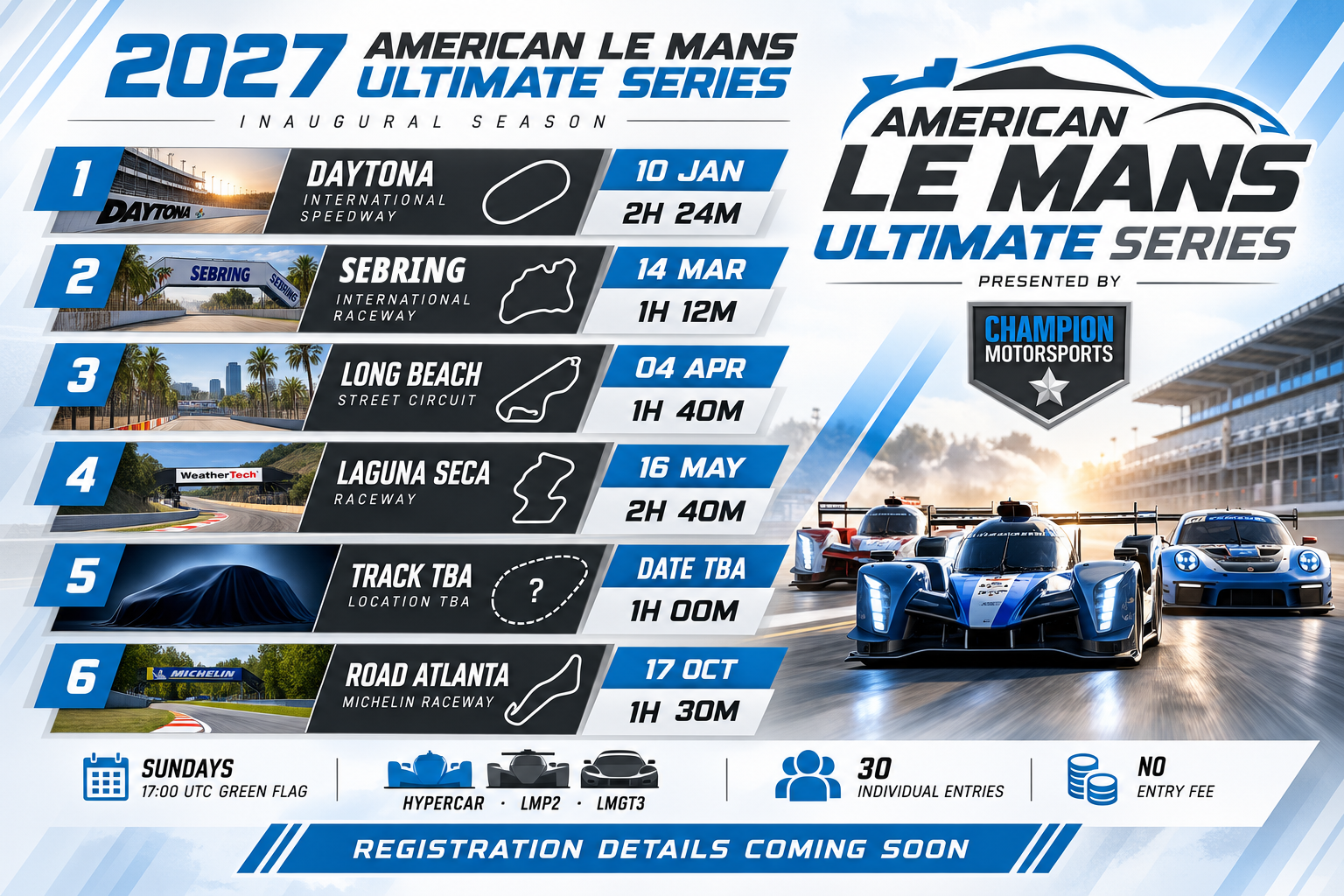
The poster is complemented by the accessible, text-based race schedule below.
10
14
04
16
17
| Round | Sunday (2027) | Track | Race length |
|---|---|---|---|
| 01 | January 10 | Daytona International Speedway | 2h 24m (144 min) |
| 02 | March 14 | Sebring International Raceway | 1h 12m (72 min) |
| 03 | April 4 | Long Beach Street Circuit | 1h 40m (100 min) |
| 04 | May 16 | WeatherTech Raceway Laguna Seca | 2h 40m (160 min) |
| 05 | To be announced | North American circuit TBA | 1h 00m (60 min) |
| 06 | October 17 | Michelin Raceway Road Atlanta | 1h 30m (90 min) |
Driver entry allocations
Three classes. Thirty individual entries.
Entry allocations represent individual drivers and their single registered car—not multi-driver teams. The grid cap is 30 entries total, with a further 16 places maximum on the combined reserve list. Priority is first come, first served once both registration forms have been received and CMS verifies eligibility.
Hypercar
Ten individual entries in LMU's top prototype class, competing for an independent Hypercar championship.
LMP2
Eight individual entries in LMU's Prototype 2 category, with its own points and class trophy.
LMGT3
Twelve individual entries in GT3 machinery, competing in the independent LMGT3 championship.
Official series document
Sporting & technical regulations — Version 2.0
Updated October 9, 2026. Series-specific provisions supplement the CMS General Competition Rules and Race Review / Incident Review Request process.
1. Eligibility, registration, reserves & attendance
1.1 — Entry requirements and priority
- ALMUS is free to enter for CMS drivers in good standing; all entries remain subject to administrative review and acceptance.
- Both registrations are required: submit the ALMUS entry on The SimGrid and the CMS Le Mans Ultimate registration form. Drivers are asked to complete both forms at approximately the same time to help CMS process entries in order.
- Entry priority is first come, first served within each class, based on when CMS has received both completed forms, subject to eligibility review and the available class places. Submitting only one form does not secure or reserve a position.
- CMS will issue an individual confirmation after reviewing both submissions, stating whether the driver has been approved for the championship grid or placed on the reserve/waiting list. A submitted application alone is not final approval.
- The racing grid is limited to 30 individual entries: 10 Hypercar, 8 LMP2, 12 LMGT3. CMS may maintain a reserve list of up to 16 additional drivers total across the three classes, subject to class suitability and vacancies. Reserve-list positions do not guarantee a race start.
- Season 1 is an individual-driver championship: one driver per car, with no swaps, shared drives, multi-car teams, or Pro/Am divisions. Drivers are encouraged to choose machinery suited to their experience; less-experienced competitors may prefer LMGT3 over Hypercar.
1.2 — Race-by-race attendance confirmation and reserve promotion
- Before each race, CMS will publish an event-specific attendance confirmation form and instructions for approved competitors. This form is separate from the two season-entry registration forms.
- Every approved driver must confirm whether they intend to race at least 48 hours before the scheduled 17:00 UTC Sunday green flag—normally by 17:00 UTC on Friday before that event.
- Drivers who cannot attend, fail to respond by the deadline, or relinquish their place may have that event's grid slot offered to an approved reserve in the corresponding class. CMS will confirm reserve promotions and may prioritize eligibility, class fit and completed application order.
- An event-by-event reserve replacement does not automatically remove the original approved driver's season entry; permanent entry changes remain at CMS discretion. Any eligible reserve who competes earns individual class championship points normally.
2. Platform, eligible cars & balance of performance
ALMUS uses official Le Mans Ultimate content (base game and applicable official DLC) on CMS's chosen latest stable build. Drivers are responsible for purchasing the base game and any DLC required for their selected car and the scheduled circuits; owning the relevant DLC is strongly recommended.
2.1 — Eligible Hypercar models (9)
- Alpine A424
- Aston Martin Valkyrie
- BMW M Hybrid V8
- Cadillac V-Series.R / V-LMDh
- Ferrari 499P
- Genesis GMR-001
- Peugeot 9X8 (2024 specification only)
- Porsche 963
- Toyota GR010 Hybrid
CMS's contemporary LMH/LMDh selection is intended to capture modern competition while maintaining manufacturer variety; inclusion is not a claim that every car has identical pace at every circuit.
2.2 — LMP2 eligibility (single chassis)
The ORECA 07 Gibson is the eligible LMP2 car. Different liveries or officially selectable versions of the same ORECA 07 platform do not constitute separate makes for championship eligibility; any significant in-sim specification differences will be reviewed prior to the opener.
2.3 — Eligible LMGT3 models (all 10)
- Aston Martin Vantage AMR GT3 Evo
- BMW M4 LMGT3
- Chevrolet Corvette Z06 GT3.R
- Ferrari 296 GT3
- Ford Mustang GT3
- Lamborghini Huracán GT3 (LMU version)
- Lexus RC F GT3
- McLaren 720S GT3 Evo
- Mercedes-AMG GT3 Evo
- Porsche 911 GT3 R (992)
All ten currently listed LMU GT3 cars are permitted. No car is excluded solely for being an older real-world model. Manufacturer variety and driving style are encouraged.
2.4 — BoP, car commitment and updates
- Default developer-provided, circuit-specific BoP is the championship baseline for all three classes. CMS does not promise that every eligible model will have identical qualifying or race pace.
- Drivers select one model in their entered class for the championship and should remain with it throughout Season 1. Model changes require advance written CMS administrator approval for technical, availability, or competition-integrity reasons. Custom liveries may change within CMS rules.
- Official LMU updates may alter vehicle behavior or BoP. CMS will use the latest suitable stable game build, announce significant changes, and may defer a disruptive update where technically possible.
- CMS may review material or unintended competitive disparities using full-stint data and preseason/event evidence. Any exceptional adjustment is subject to the available LMU server capabilities and will be communicated in advance in a sporting bulletin and event briefing. CMS will not silently change BoP.
- The eligible models listed here are approved for the inaugural season. Once the championship begins, model removals or restrictions will occur only where essential for technical, fairness or safety reasons and will be communicated to competitors.
3. Race-week timetable, private qualifying & preparation
Every round uses the standard Sunday timetable below. Times are UTC, regardless of local daylight saving time. The target green flag is 17:00 UTC.
- Private qualifying: the same 15-minute qualifying session is available to all drivers in all three classes. Qualifying will be configured as private so competitors do not encounter other cars on their qualifying laps, subject to the supported LMU session configuration. There are no separate class-only qualifying windows.
- CMS will host additional practice opportunities in the days and weeks leading up to each event; all registered drivers are encouraged to attend.
- Drivers must be familiar with LMU's normal in-game race-start procedure. Starting order, class separation and race-specific instructions will be established using the game configuration and official CMS race briefing.
- Every race will have an event briefing covering orange zone, starts, weather outlook, attendance, pit strategy limitations, and other event-specific administrative details.
4. Simulation realism, pit stops & server settings
- Events use realistic simulation conditions and dynamic weather, which may include dry, mixed or wet racing.
- Damage: 100%. Fuel consumption and tire wear: 100% / authentic.
- Only driver aids consistent with real-world vehicle capabilities, such as factory-style ABS and traction control, will be allowed under the applicable server configuration. Artificial assists may be limited.
- Driving view is unrestricted among permitted in-game camera selections.
- There is no mandatory pit stop. Drivers pit when they elect or need to add fuel, replace tires, repair damage or receive another permitted service. A driver who can complete the distance without stopping is not otherwise required to pit.
- To promote variety in race strategy and full-event resource management, CMS may set a different maximum fuel tank allowance and/or limited tire-set allocation for each round, where supported by LMU server settings. Such limits will be published in advance in the specific race briefing.
- CMS may adjust technical server settings to protect stability, sporting fairness or realism, with competitors informed as appropriate.
5. Race conduct, orange zones & communications
- All competitors must obey the CMS General Competition Rules. Established incident submission, review and stewarding procedures will apply.
- An orange zone will be designated for each race. The location and applicable conditions will be communicated in its official event briefing.
- All drivers must be connected to the designated CMS voice Discord channel for the pre-race meeting and race-control communications. There are no exceptions.
- No driver voice conversation or text chatting while the track is hot. Drivers must remain able to hear essential administrator/race-control messages. Any communication exceptions must be specifically authorized by race control.
- Drivers must follow official LMU race-control instructions and any additional CMS instructions included in the race briefing.
6. Championship points, classification & tie-breakers
6.1 — Championship points
All six planned championship races count toward the season standings: no dropped scores. Every completed round uses the same master points table, regardless of race length. Finishing positions and points are determined within each individual class—Hypercar, LMP2 and LMGT3—with one driver's championship in each class.
Eleventh place and any lower classified class position receives 0.5 point. A driver receiving a disqualification, failing classification, not starting (DNS), or failing to finish under the rules below receives zero points.
6.2 — Normal race classification: 70% and the checkered flag
To qualify for points after a race finishes normally, the driver must complete at least 70% of the lap distance covered by the race winner in that driver's own class, rounded up to the nearest whole lap, AND cross the finish line to take the checkered flag under the car's own power. Both conditions are mandatory. Race-control penalties and disqualifications still apply.
For example, if the class winner completes 39 laps, a points-eligible driver must complete at least 28 laps (70% of 39 = 27.3, rounded up) and take the checkered flag under power.
6.3 — Season standings and tie-breakers
Series points are added across all races actually conducted. If two or more drivers finish tied on championship points, CMS will first compare the number of class race victories, then second-place finishes, then third places and progressively lower classified finishes. If still tied, the better class finish in the most recent championship race decides; CMS will compare earlier rounds in reverse order if required. Any truly unresolved tie will be settled by a documented CMS sporting ruling before championship awards are finalized.
Red-flagged races may result in half points or no points under Section 7. Published results are provisional until all applicable incident reviews and administrative adjustments are resolved.
7. Red flags, server failures & interrupted races
Consistent with the CMS iRTES approach, Race Control may stop an event when technical failures, a significant mass disconnect or other circumstances prevent safe and fair continuation. Race Control has discretion over restarting, shortening, suspending or declaring an official result, depending on the conditions and LMU server capabilities.
7.1 — Less than 50% of the scheduled time completed
CMS may restart on a new server and may reduce the remaining or restarted race length if necessary. If the event cannot resume and more than 25% but less than 50% of its scheduled duration has been completed, CMS may declare a result and award half of the normal class finishing-position points, based on the last unaffected completed lap.
7.2 — 50% or more of the scheduled time completed
Where practical, Race Control may instruct cars to return to pit lane and take up the order in which they enter. If restarting is not possible, CMS may declare the official classification from the last valid completed lap before the interruption and award full class championship points.
7.3 — Results, eligibility and boundary cases
- If a race cannot be resumed after 25% or less of scheduled time has elapsed, no championship points will be awarded; CMS may reschedule or cancel the event.
- At exactly 50% of scheduled duration, the full-points framework in Section 7.2 applies if CMS declares the race official. Half points apply only to a declared race over 25% and under 50% completed.
- For an event ended permanently by a red flag, the Section 6 70% distance requirement is calculated against the class leader's credited laps at the last valid completed lap used for the official results. Because no checkered flag can be taken, the normal checkered-flag condition is waived solely for competitors still actively running and eligible to continue when the red flag occurred, as determined by Race Control. Previously retired or disqualified cars do not become eligible merely because the event was stopped.
- Any half-point award applies to the entire class master table (for example, 25 points becomes 12.5; 0.5 point becomes 0.25). Race Control's announcement will specify the official elapsed-time calculation and the lap on which the classification is based.
This section adapts CMS's established iRTES red-flag framework to timed, single-driver multiclass racing in Le Mans Ultimate.
8. Liveries, required series identifiers & broadcasting
- Custom liveries are permitted wherever supported by LMU and applicable CMS rules. Offensive, vulgar or inappropriate designs are prohibited; CMS may require removal or correction before an entry may compete.
- As the championship opener approaches, CMS plans to publish official, class-specific number boards/number plates, windshield banners and related series markings, along with application instructions and any downloadable templates.
- Once officially released, those identifiers will be required for each relevant class wherever technically supported by LMU. CMS will communicate any platform limitations or exemptions before the event.
- CMS will work with its broadcast partners to explore event coverage; live broadcasts are a goal, not a guarantee for every round.
9. Championship prizes & trophies
- One winning driver per class is eligible for the class championship award following final standings and stewarding confirmation.
- Physical trophies ship free of charge to addresses within the United States. Domestic shipping will be paid by Champion Motorsports.
- For winners outside the United States, CMS will coordinate the delivery arrangements individually; free international shipping is not guaranteed.
- There is no registration or championship entry fee.
10. Administration, sporting instructions & rules precedence
- Series lead administrator and designer: David Anderson.
- Additional CMS officials, stewards and broadcasting contacts: To be announced in a future amendment.
- The CMS General Competition Rules and established Incident Review Request process apply. These ALMUS rules govern championship-specific matters; official event briefings and sporting bulletins define the track-specific implementation of permitted rules and settings. In-game penalties remain in force unless CMS provides an authorized correction.
- If any provisions appear to conflict, CMS administration will issue a documented clarification or ruling consistent with competition integrity. Significant standing regulations changes will be announced and recorded in the version history rather than made silently.
Series administration & document control
The team and the roadmap
David Anderson
Champion Motorsports
Additional officials TBA
Supporting admins, event officials and broadcasting personnel will be announced separately.
Regulations revision history
| Version | Publication | Change summary |
|---|---|---|
| 1.0 | October 8, 2026 | Initial sporting regulations, six-round working calendar, series structure and points. |
| 1.1 | October 9, 2026 | Mandatory dual-registration workflow; 9 approved Hypercars, 10 LMGT3 models and ORECA 07 LMP2; official BoP/season car commitment; CMS light-theme branding. |
| 1.2 — Draft | October 9, 2026 | CMS registration link enabled; initial posting and navigation refinements (superseded by v2.0). |
| 2.0 — First final release | October 9, 2026 | Registration approval and 16-driver reserve cap; mandatory attendance confirmations; private qualifying; pit/fuel/tire strategies; 70% race classification; six counting rounds, tie-breaks, iRTES-style red flags; required series marks; trophies with free USA shipping. |
| Future amendments | TBA | New entries appended with dated revisions. |
ALMUS is independently organized by Champion Motorsports. It is a community sim-racing championship inspired by North American sports-car racing, not an official IMSA, former ALMS or game-publisher championship.