


iRTES Championship Finale Preview: Everything Comes Down to the Streets of St. Petersburg
One short street circuit. Two championship fights. One final Sprint. One final endurance race. After the heat and darkness of Homestead and the storm-driven strategy battle at Red Bull Ring, the 2026 iRTES season will be decided against the concrete walls of downtown St. Petersburg.
The 2026 Champion Motorsports iRacing Team Endurance Series reaches its deciding weekend September 13 at the St. Petersburg Street Circuit, and the championship could hardly arrive with more at stake.
GermanPitbullzRacing Alpha and PCA Sim Racing 963 enter the finale tied at the top of GTP after trading wins and second-place finishes in the opening two rounds. Moradness Squad arrives with a perfect two GT3 victories from two starts, but Quokka Racing has answered with two consecutive second-place finishes and remains only six points behind. The Organization Racing and Team Brake Fade still have championship paths of their own. The 50+ titles are unresolved. The Clean Team awards remain open. And before any of those prizes are settled, the field must first survive one of the most unforgiving circuits on the calendar.
The final round is also the shortest championship race of the season at 3 hours, 20 minutes. That is an important distinction. Homestead gave teams four hours to recover. Red Bull Ring gave them five. St. Petersburg offers less time, less space and almost no physical margin for error.
Finale Weekend Schedule
Sunday, September 6 — Free Practice 1
The first official group session and the opening opportunity to see which teams adapt quickly to a circuit that is unlike either of the first two rounds.
Saturday, September 12 — Free Practice 2 + Final Sprint Race
The final practice session of the season will be followed by the last Sprint Race of 2026, giving the field one final short-format rehearsal before the championship feature.
Sunday, September 13 — Round 3 Feature
Race-day practice opens at 15:30 GMT, the mandatory drivers meeting is scheduled for 16:30 GMT, solo qualifying begins at 16:45 GMT, and the 3-hour, 20-minute finale takes the green at 17:00 GMT.
A Completely Different Final Exam
The first two points races tested endurance in very different ways. Homestead-Miami was about difficult passing, high-speed transitions between oval and infield sections, four Code 60 periods and a race that moved from daylight deep into darkness. Red Bull Ring was longer, faster and more strategic, beginning dry before a steady 90-minute storm transformed the circuit, eventually producing the race's only Code 60 for track wetness before sunshine returned and the surface dried again.
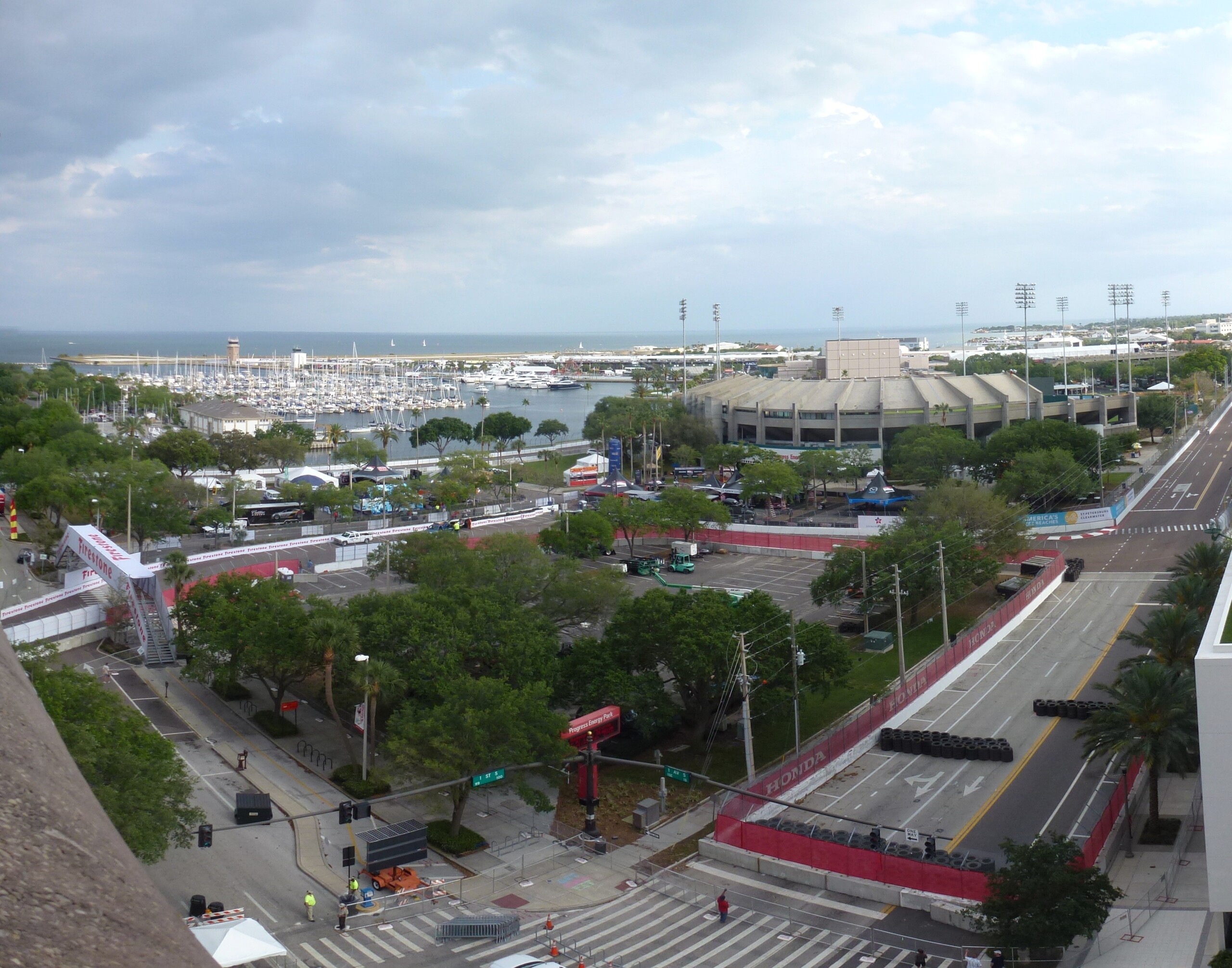
St. Petersburg removes the wide-open feeling of both venues. The walls move closer. The track width changes constantly. Public roads, purpose-built pieces of racing surface and the runway at Albert Whitted Airport are stitched together into the same lap. Surface transitions change grip and braking feel. Instead of one sustained rhythm, drivers are constantly moving between different types of road and different visual references.
That makes the finale a precision race before it becomes a strategy race.
St. Petersburg: 1.808 Miles with Almost No Place to Hide
The iRacing version of St. Petersburg is a 1.808-mile, 14-turn street circuit. It uses sections of 1st Street SW and Bayshore Drive SE, while a runway at Albert Whitted Airport forms the start-finish area. The circuit is unusually varied even by street-course standards: bumpy public roads, smoother purpose-built sections, runway pavement, concrete walls and repeated changes in width all appear within one short lap.
That short lap is one of the biggest factors for iRTES. GTP traffic will cycle through the GT3 field far more frequently than it would at a long permanent road course. A single GT3 battle may be interrupted by prototype traffic multiple times over a stint. A GTP driver may gain or lose several seconds depending on exactly where the next group of GT3 cars is caught.
Sector by Sector: Where the Finale Can Be Won or Lost
Turn 1: The First Major Risk of the Weekend
The lap begins with speed from the airport runway and immediately compresses the field into the Turn 1 complex. iRacing itself highlights this first corner as a frequent source of start-line drama because cars funnel from the wide approach into a much tighter chicane.
That makes the opening lap especially important for both class leaders. The GTP pole sitter will control the overall start, while the GT3 pole sitter controls the second class group. Everyone behind them will be balancing the natural instinct to gain track position with the reality that a first-lap incident at St. Pete can end a championship before the race has even begun.
Turn 1 should also become one of the clearest overtaking locations once the field spreads out. For GTP drivers coming through GT3 traffic, however, the closing speed into a narrow braking zone will demand discipline. A move that is routine at Red Bull Ring can become a much more serious commitment when the runoff is replaced by barriers.
Turns 4 Through 9: The Technical Heart of the Circuit
iRacing describes Turns 4 through 9 as one of the most technical sections of the St. Petersburg layout, and for endurance racing that section may be even more important than the obvious passing zones.
These are the corners where patience will matter. The road narrows, the rhythm changes repeatedly, and a car caught behind traffic can lose time without having a safe opportunity to recover it immediately. This is also where setup compromise becomes obvious. A car that is comfortable over bumps and surface changes will give its drivers confidence to repeat laps; a car that is nervous on entry or traction-limited on exit may become exhausting over a long stint.
For GT3 teams, this section could determine how much time is lost when prototypes arrive. A predictable GT3 driver who places the car consistently can often let a GTP through with minimal loss. An unpredictable move, a late change of line or an attempted pass in the wrong portion of the technical section can cost both cars dramatically more.
The Final Part of the Lap: Speed Returns
After the most technical section, the circuit opens into longer acceleration zones before a sweeping pair of right-handers concludes the lap. That creates an important contrast: St. Pete is not simply a low-speed street course. Teams still need stability and confidence at higher speed, particularly when the tires are older or the car is carrying damage.
The final corners also determine the entire run back toward Turn 1. A compromised exit can leave a driver vulnerable into the primary braking zone. In class battles, that means defending one corner may actually begin several corners earlier.
The Sunny Florida Factor
The current event plan points toward a bright, dry late-summer Florida day rather than the weather chaos seen in Austria. With the in-sim session launching at 10:00 AM, the race should progress from a sunny morning into the early afternoon.
That does not eliminate strategy. It changes the type of strategy.
Instead of reacting to rain intensity and crossover laps, teams may be reacting to a steadily evolving dry surface. Sunshine can increase track temperature as the race moves toward midday, while rubber accumulation can change braking grip and traction. Street circuits also tend to punish tire abuse because there are fewer long, flowing corners in which a driver can simply settle into a rhythm and protect the tire without losing substantial lap time.
The exact race-specific fuel and tire limits will matter greatly once the event briefing is finalized. The series regulations allow those limits to vary by round, and Red Bull Ring demonstrated how dramatically fuel capacity can shape stint timing. At St. Pete, the shorter lap and shorter total race duration may produce very different pit windows even if the underlying limits remain similar.
Qualifying Could Matter More Than at Any Other Round
Homestead already demonstrated the value of track position. St. Petersburg may take that lesson even further.
Solo qualifying gives every team a clean opportunity to set its own time, but the qualifying driver must also start the race. That forces teams to think beyond pure one-lap speed. The quickest qualifier may not always be the driver a team most wants in the car for the first traffic cycle, the opening orange-zone sequence or the critical first stint.
At a street circuit, qualifying position also determines how much immediate risk a team faces. Starting near the front can reduce exposure to incidents in Turn 1 and the technical middle sector. Starting deeper in the class may force a championship contender to spend the first half-hour making progress rather than controlling its own race.
GTP Championship: 67-67, Winner Takes Control
No manufactured drama is required in GTP. The standings already provide it.
| Pos. | Team | Homestead | Red Bull | Total |
|---|---|---|---|---|
| T1 | GermanPitbullzRacing Alpha | 32 | 35 | 67 |
| T1 | PCA Sim Racing 963 | 35 | 32 | 67 |
| 3 | The Organization Racing | 30 | 30 | 60 |
| 4 | cmsracing.com Endurance | 28 | 28 | 56 |
| 5 | cmsracing.com Titanium | 25 | 26 | 51 |
| 6 | 360 Motorsports | 26 | — | 26 |
GermanPitbullzRacing Alpha and PCA Sim Racing 963 are tied on 67 points. They have arrived there in identical fashion: one victory and one second-place finish each.
PCA won Homestead after a four-hour fight in which GermanPitbullzRacing led more laps and set the faster race lap. At Red Bull Ring, GermanPitbullzRacing reversed the outcome, leading 149 of 195 laps and beating PCA by 41.750 seconds. Even the countback remains tied because both teams have exactly one first and one second.
GermanPitbullzRacing Alpha: The Current Pace Standard
Christopher Kindler and Leon Friedrisczyk have been at or near the front in every serious GTP session. The Porsche was the fastest car at Homestead, even without the win, and converted that speed into victory in Austria. After Red Bull Ring, GermanPitbullzRacing also moved to the top of the editorial power rankings.
St. Pete asks a new question: can that raw pace survive a circuit where mistakes are punished instantly? The short lap may suit an aggressive car, but traffic management and wall avoidance will matter more than outright lap time.
PCA Sim Racing 963: Execution Has Been Its Strength
PCA's season has been almost impossible to fault. It won Homestead when execution mattered more than raw pace, then finished second at Red Bull Ring while completing all 195 laps with only 10 incidents. Across the two races, PCA and GermanPitbullzRacing have completed exactly the same 374 championship laps.
The finale should therefore become a fascinating contrast. GermanPitbullzRacing has often looked like the fastest GTP entry. PCA has repeatedly looked like the team least likely to beat itself.
The Organization Racing Is Still Very Much Alive
The Organization Racing sits seven points behind on 60 after finishing third in both championship races. Eric and Evan Bruecker have not yet beaten the two Porsche teams, but they also have not finished off the podium.
The BMW's most realistic title path begins with winning the finale. A victory would take The Organization to 95 points. Because GermanPitbullzRacing and PCA each already own a victory and a second-place finish, a tie at 95 would favor either Porsche team on countback. For The Organization to win outright with a St. Pete victory, both current leaders would therefore need to finish fifth or worse.
That is not the likely outcome — but at a street circuit, a single wall contact, tow or Code 60 sequence can turn unlikely mathematics into a very real championship scenario.
Endurance and Titanium: Fighting for the Final GTP Order
cmsracing.com Endurance enters the finale fourth on 56 points. The Acura has shown enough speed to challenge the podium, but Red Bull Ring was compromised by a disconnect after 130 laps. St. Pete offers Tarcisio Carvalho, James Sauceman and the Endurance program an opportunity to convert pace into the clean complete result the season has sometimes denied them.
cmsracing.com Titanium is fifth on 51 after receiving its corrected fifth-place GTP points at Red Bull Ring. The team suffered a technical scratch at Homestead and then completed only 42 laps in Austria, so the finale is its last chance to put together a full endurance result.
GT3 Championship: Moradness Has Match Point, Quokka Has a Chance
| Pos. | Team | Homestead | Red Bull | Total |
|---|---|---|---|---|
| 1 | Moradness Squad | 35 | 35 | 70 |
| 2 | Quokka Racing | 32 | 32 | 64 |
| 3 | Team Brake Fade | 28 | 30 | 58 |
| 4 | PCA Sim Racing GT3 | 26 | 25 | 51 |
| 5 | SOELPEC Precision Racing | 30 | 20 | 50 |
| 6 | Longhorn Racing - Chrome | 20 | 28 | 48 |
| 7 | ThumbTech Motorsport | 24 | 23 | 47 |
| 8 | SimHQ Motorsports WHITE | 19 | 26 | 45 |
| 9 | cmsracing.com AM | 16 | 24 | 40 |
| 10 | Team Black | 17 | 22 | 39 |
Moradness Squad leads Quokka Racing 70-64. The headline is simple: Moradness has won both races, while Quokka has finished second in both.
That six-point gap is meaningful but not decisive.
Moradness Squad: Two Races, Two Wins
Miguel Colon, Alex Rogers and Justin Cornett have established the strongest result profile in the series. Moradness won at Homestead with pace and racecraft, then won again at Red Bull Ring despite a race that moved from dry to heavy rain and back to dry.
That adaptability may be its biggest strength heading to St. Pete. The finale is not asking the Mercedes to survive weather — it is asking the drivers to survive walls, surface changes and relentless traffic while protecting a championship lead.
Quokka Racing: Consistency Has Kept the Door Open
Quokka has done almost everything except win. John Marjoribanks and Christian Youngwall finished second at Homestead, led FP1 pace at Red Bull Ring, and finished second again in the five-hour race.
If Quokka wins St. Petersburg, Moradness must finish fourth or worse for the championship to change hands. If Quokka finishes second, Moradness would need to fall to sixth or worse. The closer Quokka gets to the front, the more pressure it can place on the leader.
Team Brake Fade: The Outside Threat
Team Brake Fade has progressed from fourth at Homestead to third at Red Bull Ring and now sits on 58 points. James Foster and Brian Blanchette have made a habit of moving forward in the feature races.
The title path is difficult but real. A St. Pete victory would take Brake Fade to 93 points. To win the championship from there, Moradness would need to finish ninth or worse and Quokka fourth or worse.
That is a large swing — but St. Pete is exactly the type of circuit where one incident can produce it.
The Battle Behind the Title Fight
The GT3 midfield may be just as entertaining as the championship battle. Only eleven points separate PCA Sim Racing GT3 in fourth from cmsracing.com AM in ninth.
PCA Sim Racing GT3 has been fast and dependable but has yet to convert that pace into a podium. SOELPEC Precision Racing showed front-running speed in Austria but lost most of the feature to an early disconnect. Longhorn Racing Chrome is coming off its best weekend of the season — second in the Sprint, fourth in the feature and only nine incidents in five hours. SimHQ Motorsports WHITE won the Red Bull Ring Sprint and followed it with fifth in the feature.
And then there is cmsracing.com AM, the largest mover in the post-Red-Bull power rankings. After the Homestead driver-availability problem essentially erased Round 1, the team rebounded with Lance Williams second in FP1, David Nelson third in the Sprint, and Williams, Nelson and Drew Lidkea combining for seventh in the feature with only 14 incidents.
At a street course, those cleaner teams may have an advantage that does not show fully in raw championship points.
50+ Championship: Participation Becomes Part of the Strategy
The 50+ championship has its own unique finale pressure because drivers must compete in at least two events to be eligible for the season award.
GT3 50+
- James Andrew — 45 points: championship leader and already eligible after competing in both rounds.
- David Nelson — 40 points: only five points behind and also already eligible.
- Drew Lidkea — 24 points: must race St. Petersburg to meet the minimum.
- Lance Williams — 24 points: must race St. Petersburg to meet the minimum.
- Larry Ford — 23 points: must race St. Petersburg to become eligible.
- Mike Tyler — 23 points: must race St. Petersburg to become eligible.
- Matthew Overton — 18 points: must race St. Petersburg to become eligible.
Because a 50+ driver receives the same points earned by the team in a race the driver participates in, the GT3 award could shift rapidly. James Andrew and David Nelson control the current points race, but St. Petersburg participation can bring several other drivers into final eligibility.
GTP 50+
Chad Henson leads the GTP 50+ standings with 35 points from PCA's Homestead victory, but he did not participate at Red Bull Ring. He must compete at St. Petersburg to satisfy the two-event minimum. Steve Knight has not competed in either points race and can no longer reach the minimum with only the finale remaining.
The Clean Team Awards: Every Incident Now Matters
Street circuits can turn a clean-season award upside down very quickly, which makes the current incident totals particularly important.
Among the GTP teams that have run both championship rounds, PCA Sim Racing 963 leads with 22 incidents, followed by GermanPitbullzRacing Alpha with 25 and The Organization Racing with 31.
In GT3, Longhorn Racing Chrome leads with only 16 incidents, with cmsracing.com AM close behind at 19. Moradness has 30, PCA GT3 31 and SimHQ 32.
The award requires teams to compete in all three races. That means the finale is not simply about keeping the car away from the wall — it is about balancing championship aggression against a season-long cleanliness prize that can be lost in one difficult afternoon.
Why the Final Sprint Matters
The September 12 Sprint does not determine the endurance championship, but it may be the most useful Sprint of the year.
At Homestead, the Sprint helped reveal GT3 pace before the feature. At Red Bull Ring, SimHQ's Sprint victory and Longhorn Chrome's second place foreshadowed both teams' strong feature performances the next day.
At St. Petersburg, the Sprint should be even more revealing because street-course racecraft is difficult to simulate with solo practice. It will show:
- Who can actually pass without contact.
- Which cars are stable in the Turn 1 braking zone.
- Which drivers can remain precise while running close to walls.
- How difficult dirty air and traffic will make the technical middle sector.
- Who is willing to attack — and who is already thinking about Sunday's championship.
Because it is the final Sprint of the season, there is also no reason for teams to preserve a Sprint ranking or save a future opportunity. It is the last competitive rehearsal before the championship is decided.
FP1 and FP2: What to Watch on the Timing Sheets
Free Practice 1 — Sunday, September 6
FP1 should be treated as an adaptation session more than a definitive speed chart. St. Petersburg is new iRacing content for 2026, so teams have less accumulated historical data than they would at a long-established circuit.
The most interesting numbers may therefore be lap count and consistency rather than the single fastest lap. Teams that can put together long, low-incident runs will be building the foundation for the feature.
Free Practice 2 — Saturday, September 12
By FP2, the picture should become much clearer. Championship teams will be closer to final setups, driver roles should be defined, and qualifying pace will become more relevant.
The biggest question will be whether the fastest car is also the easiest car to drive. On a street circuit, that distinction matters. A setup that produces one spectacular lap but feels nervous over bumps may be a poor choice for more than three hours of endurance racing.
Code 60 at a Street Circuit
Red Bull Ring provided the first feature-race test of the revised Code 60 process. St. Petersburg may test it in a completely different way.
A street course creates a greater chance that a damaged car could be stopped in a narrow or awkward location. Under the current procedure, cars remain moving on the limiter, the pits generally remain open, the overall GTP leader becomes the effective pace car, and GTP and GT3 form behind that leader while preserving their class order. No traditional wave-by or stopping procedure is used.
The key difference at St. Pete will be physical space. Drivers slowing for a Code 60 while approaching a blind or narrow corner must be especially aware of cars behind. Restarts will also feed the field toward Turn 1, where the same compression problem that exists at the original start returns again.
Five Things That Could Decide the Finale
1. Qualifying.
Track position has mattered all season, and it may matter more here than anywhere else.
2. Turn 1 discipline.
A championship can be lost in the opening seconds. The drivers who survive the first braking zone cleanly will already have accomplished something important.
3. Multi-class timing.
The short lap will create repeated GTP/GT3 interactions. The fastest traffic manager may gain as much time as the fastest qualifier.
4. Incident control.
The automatic 25-incident drive-through and 40-incident disqualification thresholds remain in effect. At a wall-lined circuit, incident accumulation can become strategic rather than merely statistical.
5. The final hour.
A 3-hour, 20-minute race leaves less recovery time than either previous round. Teams that reach the final hour in contention will need to decide when championship points matter more than one additional position.
The Championship Pressure Is Different for Everyone
GermanPitbullzRacing and PCA can race each other directly. Moradness can afford to think about the championship before thinking about the win. Quokka needs to apply pressure. The Organization and Brake Fade need to create a result rather than simply protect one. Teams further down the order can attack for their best finish of the season without carrying the same title burden.
That difference in objectives could influence the entire field.
A car fighting for a championship may yield rather than force a marginal pass. A team fighting only for a podium may take the risk. A 50+ contender may need only to participate cleanly to preserve eligibility. A Clean Team contender may decide that one unnecessary side-by-side battle is not worth the incident risk.
The standings may be numerical, but the decisions those numbers create will play out corner by corner.
Final Outlook
The 2026 iRTES season began with a test at Okayama, moved into a difficult four-hour opener at Homestead, and then produced a five-hour Austrian race that changed from dry to heavy rain and back to dry. Each event has asked a different question.
St. Petersburg asks the final one: who can be precise when there is nowhere to make a mistake?
GermanPitbullzRacing Alpha and PCA Sim Racing 963 arrive tied, each with a win and a second. Moradness Squad arrives unbeaten but still not mathematically safe. Quokka Racing has never finished worse than second. The Organization Racing and Team Brake Fade remain close enough to punish any championship leader who stumbles. The 50+ and Clean Team awards are still open.
And all of it will be decided on 1.808 miles of runway, city streets, changing pavement and concrete walls.
Free Practice 1 begins the final chapter on September 6. Free Practice 2 and the last Sprint Race of the season arrive September 12. Then, on September 13, the green flag falls on 3 hours and 20 minutes that will decide the 2026 iRTES champions.